The federal budget landed on November 5 with a number that made every mailroom in the country look twice: the standard domestic stamp goes from $1.44 to $2 sometime in 2027, then climbs another 7% every year after that. If you run a business that still mails invoices, statements, cheques or promotional letters, you have probably already seen the headlines. What the headlines have not done is separate what is actually decided from what is still moving.
That distinction matters more than the headline number. Some of what people are repeating right now is confirmed policy. Some of it is a reporter’s reasonable guess. And one detail — whether booklet stamps rise to $2 along with single stamps — changes the math for your business by a factor of three. Here is where things genuinely stand, and what you can still do about it while the current prices hold.
Locked in versus still up in the air
Three things are settled, at least as far as the budget document and Canada Post’s own spokesperson go.
First, the single domestic stamp goes to $2 in 2027. The budget says so directly, and it frames the jump as a way of bringing Canadian pricing closer to what other OECD countries charge. After that, the price rises 7% per year, continuously. On its own estimate, that works out to roughly $6 more per year for an individual consumer and about $9 per year for a small business.
Second, United States and international letter stamps are going up too. Canada Post’s vice-president of communications confirmed this to the media in the days after the budget, though the amounts have not been decided. If your business mails across the border — contracts, samples, documents — the current $1.75 rate to the US and $3.65 internationally is on borrowed time. Nobody can tell you yet what replaces it.
Third, and this is the part that got buried: parcel prices are not part of this. Canada Post called its parcel business a market-driven product and said those rates stay put. If your shipping budget is dominated by boxes rather than envelopes, this announcement does not touch it. The fuel surcharge you pay on parcels moves with diesel prices every Monday, not with this budget line.
Now the open questions, because there are three of them and they are big ones.
Nobody has said exactly when in 2027 the new price takes effect. Nobody has said whether booklet, coil and pane stamps — the ones you actually buy in volume, currently $1.24 each — also jump to $2, or rise by a smaller amount, or hold somewhere in between. And nobody has confirmed what happens to Permanent stamps, the no-denomination stamps that are supposed to keep working at whatever the current domestic rate happens to be. Canada Post was asked directly about the P stamp policy by a trade publication and answered that it would share more information soon. That was a promise about the future, not an answer.
Until those three land, any article giving you a precise “here is your cost increase” figure is guessing. Including this one, which is why the rest of this page deals in scenarios rather than promises.

What the budget’s own math leaves out
That $9 per year figure for small businesses comes straight from the budget document, and it is worth reading closely because of what it assumes. Divide $9 by the 56-cent jump in the single stamp price and you get a business mailing somewhere around sixteen first-class letters a year. Sixteen. That is the average the budget is defending when it calls the impact “relatively limited.”
Your business may not be average. Take a modest, very common volume: 200 letters a month, all paid for at the booklet rate of $1.24. That is $2,976 a year in postage today. If the $2 rate applies to booklet stamps the same way it applies to singles, the same 2,400 letters cost $4,800 — a difference of $1,824 a year, and it compounds as the 7% annual increases stack up behind it. The Canadian trade press did a version of this calculation when the budget dropped and noted that a flat $2 booklet rate would represent an increase of more than 61%.
Two things follow from putting those numbers side by side. The budget’s estimate is honest for what it measures — the occasional-mailer economy — and nearly useless for anyone running a regular mail program. And the single most important unknown for your planning is not the date. It is whether the booklet rate gets dragged to $2 or lands somewhere lower. Watch for that announcement more than any other.
The one move that still works today
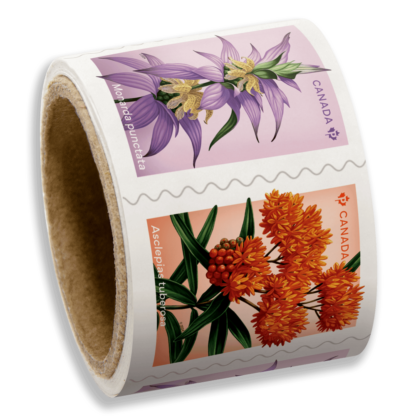
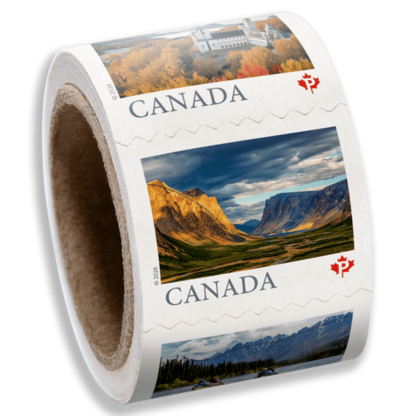
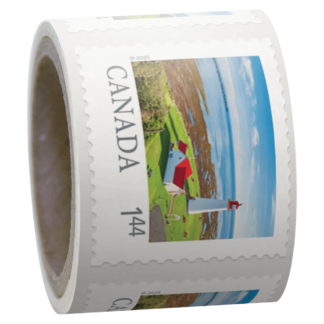
There is exactly one mechanism that lets a small business pre-purchase domestic postage at today’s prices, and it has existed for years: Permanent stamps. A P stamp carries no dollar value. It is always accepted at the current domestic postage rate, even after rates go up — that language comes from Canada Post’s own stamp pricing page and has survived every increase so far, including the 25% jump in January 2025. The difference between P stamps and metered postage, and why the stamp side wins for volumes like yours, is covered in our Permanent versus metered comparison.
Booklet and coil stamps bought today are P stamps. At $1.24 each, a coil of 100 Permanent stamps holds $124 of postage that will still be working after the increase lands. Whether that remains true under the 2027 regime is one of the unanswered questions listed above, and honesty requires saying so. But the P stamp mechanism is written into how these stamps are sold, it has held through two straight years of increases, and Canada Post has given no indication it is ending. If you were going to buy postage this quarter anyway, buying it as P stamps at $1.24 is the only version of that purchase the increase cannot touch.
What does not work: hoarding old-denomination stamps as a speculation. They still work — Canada Post accepts older stamps with face values, combined until they reach the current rate — but they were printed at values like $1.07 or $0.92, and stacking four or five of them on one envelope is a bookkeeping chore, not a saving. The P stamp coil does the same job with one stamp per letter.
There is also the volume path, briefly. Canada Post’s Incentive Lettermail program starts at 1,000 pieces per mailing with rates from $1.23 — a penny under the booklet price, which tells you how much room is really left at the bottom of the market. Most businesses mailing a few hundred letters a month never clear that threshold, which is why the booklet-and-P-stamp route remains the practical floor. Our breakdown of who actually qualifies for Canada Post’s letter discounts covers that arithmetic in detail.
How the effective date actually gets decided
The missing date is not bureaucratic shyness. It is process. Under the Canada Post Corporation Act, the company cannot raise stamp prices without approval from Governor in Council — the federal cabinet — and it cannot exceed the consumer price index without explicit cabinet sign-off. The proposal has to be published in the Canada Gazette for public comment first, and the whole path from proposal to effective date can stretch to nine months.
The last round of increases shows the rhythm. Canada Post started the process in spring 2024, the proposed rates appeared in the Canada Gazette in early September 2024, final approval came in late November, and the new prices took effect January 13, 2025. Roughly nine months, start to finish, with the Gazette notice appearing about four months before the increase landed.
Apply that template to a 2027 increase and the practical reading is this: a Gazette notice would need to appear by roughly mid-2027 for the new price to land within the year, and the minister has already said the rate-setting process is being modernized and shortened, which could compress that timeline. When the Gazette notice appears, the exact date, and usually the treatment of related products, becomes public. That is the signal worth watching — not the budget, which only announced an intention, and not the daily news cycle.
We track this as part of covering Canadian postage for small businesses, and this page’s numbers reflect what is confirmed as of late November 2026. When the Gazette notice lands or Canada Post clarifies the booklet and P stamp questions, the tables on our full 2026 rate guide get updated the same week.
What to do between now and then
Keep mailing at current prices, and keep buying postage the cheap way while the cheap way lasts. Booklet and coil stamps at $1.24 remain the lowest per-letter cost any regular mailer can access without a commercial agreement, and every stamp you buy now is a stamp the 2027 increase does not apply to. Compare the full current price list before your next purchase, and if a meaningful share of your volume crosses the border, hold a little flexibility in the budget for the US and international increases that are coming without a published number.
The increase is real, it is large by the standards of the last decade, and it is not immediate. Businesses that treat the next several months as a buying window at old prices will come out of it measurably ahead of the ones that waited for the Gazette to tell them it was over.

Former USPS employee with 5 years of service and 25 years in corporate mailing management. Certified in Mail Systems Management and trained at the USPS Business Mail Academy, Kobe now shares trusted guidance on U.S. postage stamps and safe buying practices after retiring in 2023.