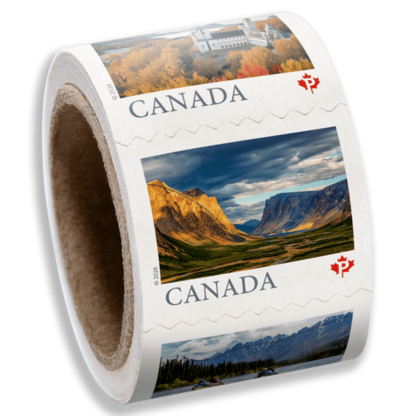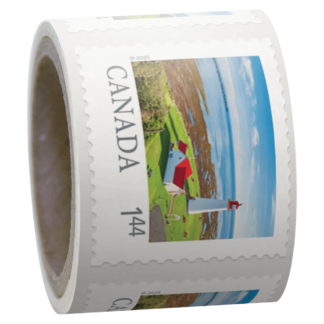
For the most common version of this question — a flat A4 document envelope weighing 100 grams or less, mailed within Canada — the answer is two single stamps, or one single stamp plus one booklet stamp. A large envelope in that weight band is classified as non-standard mail and costs $2.61 to send, and since a single domestic stamp is worth $1.44, two of them give you $2.88 of postage, which covers the rate with 27 cents to spare.
That is the short version. The longer version matters, because “large envelope” is doing a lot of work in that sentence, and because the stamp combinations get awkward fast once your envelope is heavier than a handful of pages. Here is the full picture, using Canada Post’s current published rates.
First check whether your envelope is actually non-standard
Canada Post sorts letter mail into two streams, and the dividing line is not weight. A standard-size letter is your ordinary number-10 business envelope or smaller greeting card — light, thin, and flexible enough to ride through the sorting equipment. Anything bigger, thicker or stiffer falls into the non-standard and oversize category, which Canada Post describes as covering large documents, oversize envelopes and heavy cards.
The trap is that a letter can be almost weightless and still be non-standard. A single sheet of cardboard, a padded mailer, a certificate rolled into a stiff envelope, an invitation with a wax seal — any of these can fail the size or flexibility test while weighing less than 30 grams, and the moment it does, it pays the non-standard rate, not the $1.44 standard rate. Weight only sets the price within the category. Size and shape decide which category you are in.
So before you count stamps, run the envelope past the three things the counter clerk will check: the length and width of the envelope, how thick it is when flattened, and whether it bends. If it is clearly bigger or stiffer than a normal letter envelope, plan for non-standard postage. When in doubt, the postal clerk will classify it for you, and the official stamp prices page lists both categories side by side.

What a large envelope costs across Canada
Non-standard and oversize letter mail is priced in 100-gram bands up to a hard ceiling of 500 grams. Past that, you are into parcel territory and the letter rates below no longer apply. These are domestic rates, current as of late 2026, from the same table you will find on our 2026 rate guide:
| Up to 100 g (roughly 20 sheets of paper) | $2.61 |
| Over 100 g up to 200 g (up to about 40 sheets) | $4.29 |
| Over 200 g up to 300 g (up to about 60 sheets) | $5.98 |
| Over 300 g up to 400 g (up to about 80 sheets) | $6.85 |
| Over 400 g up to 500 g (up to about 100 sheets) | $7.36 |
The sheet counts are the rule-of-thumb estimates Canada Post publishes — actual weight depends on the paper. A ream of standard office paper runs about 500 sheets per 2.5 kilograms, so fifteen sheets plus a manila envelope lands you comfortably inside the first band. Two dozen stapled contracts with a divider sheet can cross into the second band without looking heavy, which is why the kitchen-scale habit saves money: the difference between band one and band two is $1.68, and the difference between guessing right and guessing wrong at the counter is a returned envelope.
Which stamps to use, and what the combinations really cost
Stamps do not come in a $2.61 denomination, so mailing a large envelope is always a small arithmetic exercise. You combine stamps until their total value reaches the rate. These are the honest numbers for the first weight band:
- Two single stamps ($1.44 each): $2.88 total. Covers $2.61 with $0.27 of overpayment. The simplest answer, and what most people do.
- One single plus one booklet stamp ($1.44 + $1.24): $2.68. Covers the rate with just seven cents to spare — the closest fit available off the shelf.
- Three booklet stamps ($1.24 each): $3.72. Covers it, but leaves $1.11 on the table. Booklet stamps are the economy buy for standard letters, and this is the one place that economy works against you.
Notice the reversal. For ordinary letters, the booklet stamp at $1.24 beats the single stamp at $1.44 and everybody should be buying booklets. On a non-standard envelope the logic flips: the higher-value single stamps close the gap to $2.61 with less waste. If your business mails a mix of standard and large envelopes, keep both formats in the drawer and reach for the singles when the envelope is the big one.
The same combining logic scales up through the weight bands, just with more stamps per envelope. A 150-gram envelope at $4.29 takes three singles ($4.32, two cents over — the best fit in the whole table) or two singles plus two booklet stamps ($5.36). A 250-gram envelope at $5.98 takes four singles ($5.76 — just short, so add a booklet stamp for an even $7.00) or two singles plus three booklet stamps ($6.60). Past the second band the stamp stacks start looking silly, and that is usually the point where a business mailing heavy documents regularly should look at prepaid envelopes or a franking arrangement instead of tiling stamps across the flap.
Mixing old stamps with new ones
Canada Post has no problem with old stamps. Older issues showing dollar values — the $1.07 stamps from 2020, the $0.92 booklet stamps, anything older that was valid when issued — remain usable on your mail. The rule is simple: the combined face value of everything on the envelope has to reach the current rate for that mail type. If it falls short, the post office can make up the difference, but an envelope that arrives underpaid gets charged to the recipient or delayed, so the counting happens before the mailing.
Permanent stamps fit into this too. A P stamp has no printed value; it is always accepted at the current domestic postage rate, which today means it counts as $1.44 toward any domestic letter postage. Two P stamps on a large envelope give you $2.88 of postage and cover the first weight band the same way two modern singles do. A P stamp plus an old $1.07 stamp plus an old $0.92 stamp totals $3.43 — enough for the first band with change left toward nothing, but valid.
One forward-looking note, since it will change this arithmetic: the federal budget has announced that the domestic stamp rate rises to $2 in 2027, and the rate you are combining stamps to reach will move with it. The combining rules themselves are not changing — only the target. Businesses that want to freeze today’s rates can look at Permanent stamp coils bought at the current booklet price, which we explain alongside the full 2027 increase picture.
Sending a large envelope to the United States or overseas
Cross-border large envelopes leave the domestic table entirely. Current rates for non-standard and oversize letter mail start at $4.29 up to 100 grams to the United States and $8.60 up to 100 grams internationally, and climb steeply through the heavier bands — $14.99 to the US and $29.96 international in the 200-to-500-gram range. A stack of documents that costs $2.61 to send across town can cost more than five times that to send across an ocean.
Stamp-wise the same combining rules apply, and this is where a coil of higher-value stamps earns its keep, because tiling twenty-five booklet stamps across an international document envelope is neither elegant nor quick. Whatever you use, the practical checklist stays the same: weigh the filled envelope, confirm the destination band, combine stamps to the exact rate, and keep a record of what you applied. For businesses that mail documents abroad often enough for the arithmetic to matter, our guide to calculating postage with stamps walks through the bookkeeping side of it.
And the 500-gram ceiling applies everywhere. A large envelope that tips past half a kilogram is a parcel in Canada Post’s eyes no matter how flat it is, and parcel pricing works differently enough that stamps stop being the tool for it.

Former USPS employee with 5 years of service and 25 years in corporate mailing management. Certified in Mail Systems Management and trained at the USPS Business Mail Academy, Kobe now shares trusted guidance on U.S. postage stamps and safe buying practices after retiring in 2023.