Canada Post has published its official holiday mailing deadlines for Christmas 2026, and if your business sends cards, cheques, invoices, or client gifts in December, these dates deserve a permanent spot on your planning calendar. The dates quietly went live on the carrier’s holiday sending guidelines page in October, and most shipping blogs have not caught up yet. That gap matters, because every December the same pattern repeats: a small business owner in Calgary assumes the mail will behave like it did in November, discovers that Canada Post holiday mailing deadlines 2026 arrived several days earlier than expected, and spends the last week before Christmas apologizing to clients instead of celebrating with them.
This guide collects every published deadline in one place, explains how the local, regional, and national zones work, and translates the dates into a working backward schedule you can actually run an office with. Bookmark it, share it with your admin team, and treat it as the operational checklist it is meant to be.
How Canada Post Holiday Deadlines Work
Before the tables, one piece of architecture. Canada Post divides the country into three internal zones for holiday planning. Local covers mail that is delivered within the same city or town where it was mailed. Regional covers mail travelling within the same region or province. National covers everything crossing provincial lines to distant corners of the country. The same letter mailed from the same desk can carry three different deadlines depending on where it is going, which is why a national client list needs more planning than a local one.
The second piece of architecture is service level. Regular Lettermail and Regular Parcel are the cheapest and the slowest, so their deadlines arrive earliest. Expedited Parcel, Xpresspost, and Priority sit progressively higher on both price and speed, buying you extra days in exchange for a higher per-piece rate. The published dates also assume big-city to big-city travel; a card going from St. John’s to a rural community in northern British Columbia is negotiating a longer reality than the table suggests. Canada Post states this explicitly, and it is the single most common reason a card mailed “on time” still arrives late.
Domestic Greeting Card Deadlines for Christmas 2026
For cards and letters travelling by regular Lettermail inside Canada, the official 2026 dates are:
| Destination Zone | Last Day to Mail Cards |
|---|---|
| Local (same city or town) | December 22, 2026 |
| Regional (within the province or region) | December 21, 2026 |
| National (across the country) | December 18, 2026 |
Those dates line up with Canada Post’s normal letter delivery standards of two business days locally, three within the province, and four across the country. In other words, the deadlines already include the December volume surge. Do not negotiate with them by assuming your card is the exception; sorting plants in December run hot, but the published standards are the only promise on the table.
Domestic Parcel Deadlines for Christmas 2026
If your December includes gift baskets, promotional parcels, or e-commerce orders, the parcel table is where the real deadlines live:
| Service | Local | Regional | National |
|---|---|---|---|
| Priority | Dec 23 | Dec 23 | Dec 23 |
| Xpresspost | Dec 23 | Dec 22 | Dec 22 |
| Expedited Parcel | Dec 22 | Dec 18 | Dec 14 |
| Regular Parcel | Dec 21 | Dec 16 | Dec 10 |
Look at the spread between Regular Parcel and Priority for national destinations: fourteen days. That gap is the price of procrastination made visible. A parcel handed over on December 11 by Regular Parcel may still make it to Halifax by Christmas; the same parcel handed over on December 15 will not, no matter how nicely the clerk stamps it. Businesses that ship a national batch every December should treat December 10 as the real national deadline and let Priority exist as an emergency tool, not a plan.

International Card Deadlines for Christmas 2026
Cards crossing borders need the most runway, and the 2026 dates compress differently by region:
| Destination | Last Day to Mail Cards |
|---|---|
| United States | December 11, 2026 |
| Europe and the United Kingdom | December 9, 2026 |
| Asia | December 9, 2026 |
| Australia | December 9, 2026 |
For parcels moving on tracked international services, the published dates are December 17 for Xpresspost USA, December 14 for Expedited Parcel USA, and December 11 for Tracked Packet and Small Packet items. On the international side, Xpresspost International to Europe and the United Kingdom carries a December 15 deadline, while China, Australia, and Japan carry December 14. Customs clearance adds variance that no table can fully capture, so international mail deserves the widest safety margin of anything on your list.
Turning Deadlines into a Working Schedule
A deadline table becomes useful when it is run backward through your own production reality. If your national cards must be mailed by December 18, and your team needs three working days to print, sign, stuff, and address them, then December 15 is the day the printing has to start. If you mail internationally, the first week of December is already production week. The businesses that glide through December are not faster; they simply started earlier because they converted the official dates into internal ones.
Three practical rules make the schedule stick. First, batch by destination zone: run local and regional mail in one session and national mail in another, so a late-running local batch never holds national pieces hostage. Second, weigh everything before the deadline week, because a card that creeps past 30 grams pays the 30–50 gram rate, and a parcel that crosses a weight bracket can jump in price noticeably. Third, buy postage before the rush; a coil of Permanent domestic rate stamps bought in November means zero lineups in December, and the Permanent symbol keeps working at the current rate even after future increases.
What the Deadline Season Costs
Postage budgeting deserves a sentence here even in a deadline guide. Current letter rates run $1.44 for a single domestic stamp or $1.24 per stamp in booklet and coil format, $1.75 for a standard letter to the United States, and $3.65 for international destinations. If you want every rate bracket in one place, our Canada Post stamp price guide for 2026 keeps the full table current. The budgeting point that matters for December is simpler: deadlines punish businesses that improvise, and improvised postage is almost always the most expensive postage, because it is bought in singles at the counter while the queue grows behind you.
If your card program is large enough that postage is a line item rather than a errand, planning the holiday batch as a bulk purchase changes the math. Our guide to buying holiday stamps in bulk in Canada walks through how volume buying works before the seasonal rush, and the savings compound across a few hundred cards.
Picking the Right Stamps for the Season
Deadlines are only half of a holiday mailing program; the other half is what the envelope looks like when it arrives. Canada Post’s 2026 holiday stamp issues give you options that read as festive rather than generic, and choosing them takes no extra time at the counter. For teams that want seasonal imagery with a specific tone, our roundup of religious Christmas stamps for the 2026 season covers the traditional options, while Hanukkah stamps for 2026 holiday mailing serves clients celebrating the Festival of Lights. A card that arrives on time wearing the right stamp does quiet branding work that no email can replicate.
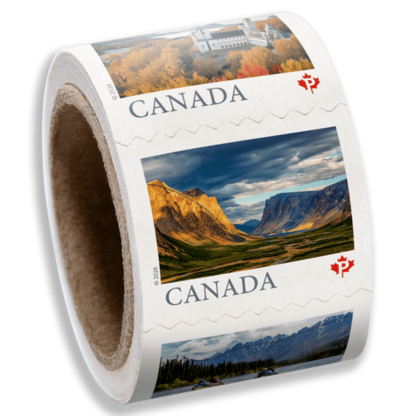
For the envelopes themselves, a coil of 50 Permanent wildflower stamps is a practical desk-side companion through December: always at the current domestic rate, always ready, and never dependent on a counter visit during the busiest mailing weeks of the year.
Frequently Asked Questions
What is the last day to mail Christmas cards in Canada for 2026?
For regular Lettermail cards, the last recommended mailing dates are December 22 for local delivery, December 21 for regional, and December 18 for national destinations. Mail after those dates and Canada Post makes no promise of Christmas arrival at regular letter rates.
What is the last day to ship parcels in Canada before Christmas?
It depends on the service. Regular Parcel deadlines run from December 10 (national) to December 21 (local). Expedited Parcel buys you until December 14 nationally, Xpresspost until December 22, and Priority accepts parcels until December 23 for Christmas Eve delivery anywhere in Canada.
When should I mail Christmas cards to the United States from Canada?
December 11, 2026 is the published deadline for cards to the U.S. at regular rates. Because cross-border mail passes customs, we recommend mailing a few days early rather than treating the deadline as a target.
Do the published holiday deadlines guarantee delivery?
No. The dates are calculated between major urban centres, and Canada Post notes that actual timing depends on origin and destination. Rural, remote, and northern destinations should add buffer days. Priority and Xpresspost carry money-back guarantees on their normal terms, but the practical habit is the same: mail early, sleep well.
Do Permanent stamps still work during the holiday rush?
Yes. Permanent stamps are always accepted at the current domestic postage rate regardless of when you bought them, so a booklet purchased last year mails a card this December without top-ups. That rate protection is exactly why we recommend stocking Permanent stamps before the season instead of buying singles in December.
How early should a small business start its holiday mailing program?
Work backward from the deadlines. International mail should be in production during the first week of December, national cards by mid-December, and everything should be weighed, stamped, and batched before the second week of December so the deadline week is a hand-off, not a scramble.
The deadline table is public, the dates are fixed, and the businesses that read them early are the ones whose cards land on time. Print the tables, mark your calendar backward from December 18 and December 22, and let the scramble happen to someone else this year. For the full official schedule, see Canada Post’s holiday sending guidelines, and keep this page handy as your working copy.

Former USPS employee with 5 years of service and 25 years in corporate mailing management. Certified in Mail Systems Management and trained at the USPS Business Mail Academy, Kobe now shares trusted guidance on U.S. postage stamps and safe buying practices after retiring in 2023.